Introduction
It sounds cruel, but the Corona virus will simmer for a while, experts tell us to expect a second wave when lockdowns will ease and then another attack will follow next winter, with new restrictions and quarantines. Many governments are justifying these restrictions with a simple explanation there is no alternative. There is no single correct solution. We are all on a common search for the right way.
You can take any economic or political risk analysis; a pandemic is invariably within the top 10 risks. And yet, we have not seen this coming, no one in the world was prepared, no country or company had made the right provisions, no country or company had the correct or even a “prepared” answer ready. It soon became clear that liberal and totalitarian politics, neo-liberalism, capitalism, communism, nationalism or fascism had no answer to the Corona virus. Every political and economic system shakes on its foundations, and the longer this will take, the faster it will shake. And if it lasts too long, every House of Cards falls down. And then what?
What kind of World do we want to live in? That may be the defining question of our era. If we want to sustain Humanity, we must answer it correctly.
Cloots – 18th Century political thinker – “All people are unified in a universal community based on human rights. And this is achievable, given that all share the same goals of liberty, equality, security, justice and the protection of property and peace and from oppression.”
An urgent need to mitigate Global Risks.
Antonio Guterres – UN Secretary General – January 2020 – “I would use two words to describe the state of the world today: uncertainty and instability.”
The Global Risks Report, published by the World Economic Forum (WEF) provides a rich perspective on the major threats that may impact global prosperity in 2020 and over the next decade.
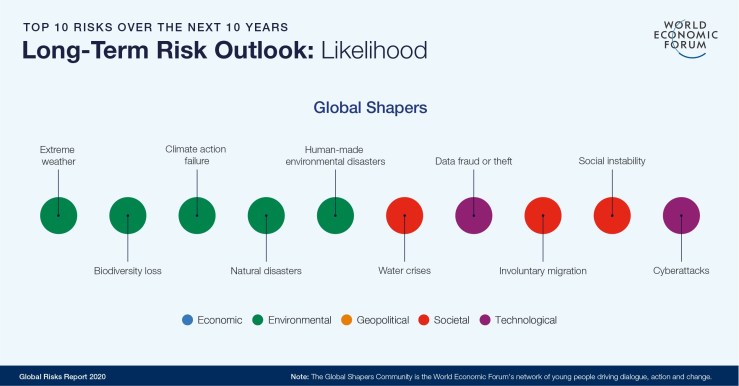
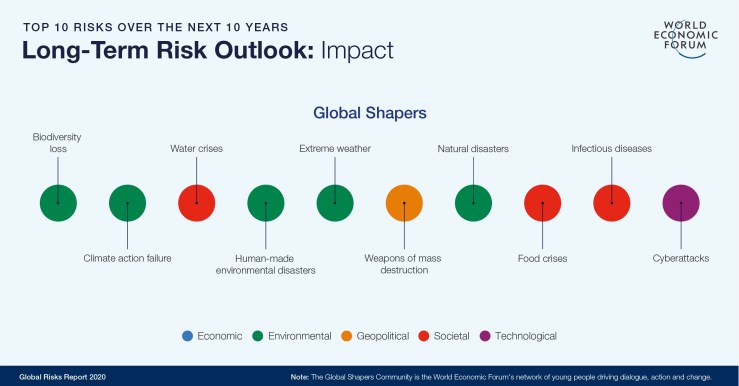
Industrialization, technology revolutions and the associated globalization has helped billions of people out of poverty, a large proportion of the world’s population today enjoys historically unprecedented material prosperity. But it has also wreaked havoc in many parts of the World. Neo-liberalism has made many dreams come true for too little people. It has fueled inequality and especially weakened the collective, leaving not enough resources to arm itself against the many risks in this world, a pandemic is just one of the many risks that threaten humanity.
All over the world, the existing models are being called into question: The Chinese communist dictatorship is fighting for its survival, President Putin has doubts about taking absolute power, both the European Union and the United States are falling apart, consumption has evaporated and the endless growth economy has almost dried up, and all of that in less than 90 days.
Today’s global risks need global solutions, and those solutions need to be fairly distributed so they can work for all of us. At the heart of these solutions lay the universal principles of justice, of the reciprocity and equality of the human rights and of the respect for the dignity of human beings as individual persons. Climate, pandemics, trade, peace, security, financial stability, migration, food and water are global themes and we must promote international collaboration to meet these challenges.
The development of consciousness and a new enlightenment.
Democracy, human rights and humanitarian international law are in historical perspective very recent developments. The socio-political dynamic of development is undergoing a fundamental change, one which increasingly excludes the use of force. The use of force is no longer acceptable between states. The desire to wage war or to conquer is a relic of an archaic mentality that is gradually being overcome. A third world war would destroy world civilization. Among the psychological factors responsible for the declining use and acceptance of force we notice the rise of empathy, self-control, morality and rationality. European integration demonstrates that it is perfectly possible for states to relinquish their rights of sovereignty in a gradual, peaceful and cooperative way. A large proportion of the world’s population has understood that humanity has to take responsibility for the actions of the human race in order for life on Earth and humanity itself to have a future.
Jeremy Rifkin – Empathy is the soul of democracy. The evolution of empathy and the evolution of democracy have gone hand in hand throughout history. The more empathic the culture, the more democratic its values and governing institutions.
Vaclav Havel – The Salvation of this human world lies nowhere else than in the human heart, in the human power to reflect, in human humbleness and in human responsibility. Without a global revolution in the sphere of human consciousness, nothing will change for the better in the sphere of our Being as humans, and the catastrophe towards which this world is headed, whether it be ecological, social, demographic or a general breakdown of civilization, will be unavoidable.
Mikhail Gorbachev – New Thinking – Ultimately, human beings, with the gift of reason, must understand that they are global human beings, individuals who must take responsibility not only for themselves and their own fate, their own community, but also for planet Earth, for the whole of humanity.
Seven Key Themes
WEF has identified 7 key themes that were covered over the 2020 Annual Meeting and 7 key questions that they want us to answer to. The answers to these questions shouldn’t just come from business leaders, governments, academics and social influencers – they also need to come from all of us.
 @PaulVanBeveren