How do we create a more equal world for everyone?
Since World War II, average life expectancy across the globe has risen by 30 years. Meanwhile, access to health and education has lifted billions out of poverty. But wealth inequality within many nations has soared, social mobility reversed, and cohesion undermined. Now there are fears new technology will make things worse. How do we reshape economies so that growth benefits the many and not just the few and so ensure that the extraordinary engine of human development we built is made sustainable?
Karl Polanyi – Great Transformation.
I need to introduce the “Great Transformation”, a 1944 work written by Karl Polanyi, and it is not just a slogan for his project of creating a sustainable world society. It is a complex picture of the origins and development of the modern, market economy based industrial society and of its inherent social, political and economic tensions. A prospering and democratic society can only be achieved by a social market economy that holds a balance between the forces of free markets and state interventionism. We need a better regulation of the market economy so that it operates in a manner that is not only socially but ecologically sustainable. The social concept that emerges from this is that of the “eco-social market economy”.
Meet all commitments and obligations to human rights in international treaties and conventions!
All countries must uphold the rights. These rights are articulated in the Universal Declaration of Human Rights, as well as other widely agreed human rights documents. Even countries that are party to these agreements can do more: they can embed equal rights into their national laws and norms. Making equal a legal principle, especially at the highest level, such as a constitution, van lay groundwork for ending discriminatory laws and practices.
Article 25:”Everyone has the right to a standard of living adequate for the health and well-being of himself and of his family, including food, clothing, housing and medical care and necessary social services, and the right to security in the event of unemployment, sickness, disability, widowhood, old age or other lack of livelihood in circumstances beyond his control”.
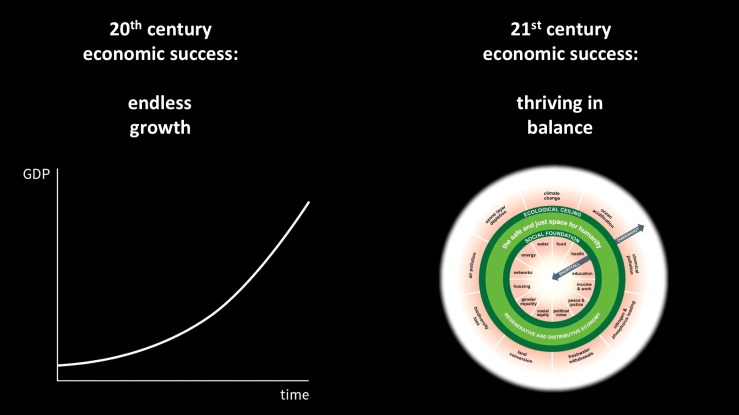
The Doughnut Economics (Kate Raworth)
Humanity’s 21st century challenge is to meet the needs of all within the means of the planet. In other words, to ensure that no one falls short on life essentials (from food and housing to healthcare and political voice), while ensuring that collectively we do not overshoot our pressure on Earth’s life-supporting systems, on which we fundamentally depend – such as a stable climate, fertile soils, and a protective ozone layer. The Doughnut of social and planetary boundaries is a playfully serious approach to framing that challenge, and it acts as a compass for human progress this century.
The environmental ceiling consists of nine planetary boundaries, as set out by Rockstrom et al, beyond which lie unacceptable environmental degradation and potential tipping points in Earth systems. The twelve dimensions of the social foundation are derived from internationally agreed minimum social standards, as identified by the world’s governments in the Sustainable Development Goals in 2015. Between social and planetary boundaries lies an environmentally safe and socially just space in which humanity can thrive.

Challenging Gender Discrimination!
We are influenced by gender. Gender norms (or rules) tell us what is appropriate for girls and for boys, women and men to do in our society. Because of gender stereotypes, girls and women are often less valued and have lower social status.
Denying people the freedom to choose their path in life because of their gender prevents them from fulfilling their full potential.
World Bank research found that there is widespread discrimination against LGBTI people in the labor markets. For instance, three-quarters of transgender people, half of gay males, and two-thirds of lesbian respondents said their job applications were refused because of sexual orientation or gender identity.
President Kim at IDAHOT 2018 – “No country, community, or economy can achieve its full potential – or meet the challenges of the 21st Century – without the full and equal participation of all its people.”
#NoMoreSecretAllies on Race Discrimination (ChallengingRacism.org)
We have to dismantle the interactions and structures of racism by creating a deep understanding of institutional racism and a passion to end racism in oneself, at home, at work, and in the institutions of the community. We have to empower citizens to disrupt racism, wherever they find it, through facilitated conversations built upon facts, stories, refection, relationships, and the basic skills of listening and holding difficult conversations to bring change.
9 Million people die of hunger every year!
A sufficient and adequate food supply is the basis for every human existence. It is one of the most fundamental human rights (together with the right for water, shelter and a safe life). The consciousness of our shared human identity lies at the foundation of the right to food. No one can tolerate the destruction from hunger of his fellow man or woman without endangering his own humanity, his very identity.
Global food supply is fragile. There are many ecological challenges like the degradation of the soil, water scarcity, temperature rise and pollution. Also, the distribution causes concern; at present, around a third of all food produced for human consumption worldwide is going to waste. Food security is a global responsibility!
Basic Access to Water.
Along with food, water is fundamental to human survival and to civilization. Basic access to water is a fundamental political, economic and social right for both individuals and collectives, since the biological, economic and social security of every human being and every human community depends upon enjoyment of that right! Close to 1 Bn people lack access to safe drinking water and more than 2.6 Bn do not have access to basic sanitation. 68 countries suffer from severe or very severe water stress. 700 million people are at risk of being displaced by intense water scarcity by 2030.Water scarcity is a potent fuel for wars and conflict. Water is a common global heritage to humanity and should not be in private hands!
The elimination of Poverty.
The elimination of poverty and of existential misery is the basis for a humane, just, peaceful and safe world, in which all people have the opportunity of education, political participation and self-fulfillment. Poverty is a major cause of hunger and inadequate access to drinking water, poor health care, inadequate education, a lack of family planning, and political instability. As a rule, a higher standard of living is associated with lower birth rates, meaning that overcoming poverty can contribute to slowing down world population growth. It would cost 250 Bn USD per year to eliminate extreme poverty across the world. There is plenty of money available if we disarm!
A New Approach to International Development.
Development Aid leads to corruption and political dependence, fuels conflicts over the control of power, undermines the efficiency of public administration, damages business and chokes of economic development and growth. We need to re-think completely the distribution of development funds!
Household debt influences inequality and vice versa.
Debt is a two-edged sword. Used wisely and in moderation, it clearly improves welfare. But, when it is used imprudently and in excess, the result can be disaster. For individual households, overborrowing leads to bankruptcy and poverty. Over-indebtedness can be the cause, but also the consequence of (i) financial and social exclusion, (ii) health issues such as depression and back pain and (iii) risky life events such as divorce and suicide.
Welfare services and policies help to avoid over-indebtedness and/or guarantee access to services and a basic level of well-being. Financial education can improve the capability of individuals to understand the consequences of their spending decisions.
Debt counselling can provide over-indebted citizens with a perspective to regain control over their financial situation.
The End of Corruption!
To end corruption, we must promote transparency, accountability and integrity at all levels and across all sectors of society. We need to focus on issues with the greatest impact on people’s lives and hold the powerful to account for the common good. We need to expose the systems and networks that enable corruption to thrive. Our vision should be a world in which governments, politics, business, civil society and the daily lives of people are free of corruption.
Delia Ferreira Rubio – Chair Transparency International – “People’s indifference is the best breeding ground for corruption to grow. Only by working together can we hope to end impunity for corruption and the corrupt.”
Sadhguru – “We need a wider base for economic growth in the world. Today, the verticals of the economy are too narrow, to small and rests on the shoulders of only a few wealthy people. 1.6 Billion people will migrate over the next decades because they live in impoverished parts of the world where nobody wants to invest, they have no livelihood or economic opportunities. We need “soft” (human and compassionate) money which we can invest with less aggressive returns in small businesses in these parts of the world, and give people a future.”
 @PaulVanBeveren